1. The Evolution of the Vision
The UAE’s agentic-AI mandate did not appear overnight. It is the operational sharp end of a strategy first articulated almost a decade earlier, sharpened in 2026 into a series of rapid, sequential commitments that moved from national ambition to government mandate, to private-sector obligation, to a concrete delivery deadline. Understanding that sequence is essential to reading the mandate correctly.
Oct 2017 – The vision is set. The UAE launches the UAE Strategy for Artificial Intelligence – the first national AI strategy in the region and the world – and appoints the world’s first Minister of State for AI. The accompanying National Strategy for AI 2031 targets making the UAE a global AI leader by 2031.
23 Apr 2026 – The government mandate. Under directives of President Sheikh Mohamed bin Zayed Al Nahyan, Vice President and Prime Minister Sheikh Mohammed bin Rashid Al Maktoum unveil a framework to convert 50% of government sectors, services and operations to agentic AI within two years – described as a global first. A taskforce chaired by Cabinet Affairs Minister Mohammad Al Gergawi is formed to drive execution.
4 May 2026 – Extension to the private sector. Eleven days later, Dubai Crown Prince Sheikh Hamdan bin Mohammed launches a parallel two-year agentic-AI transformation for Dubai’s private sector, with dedicated training tracks across Dubai Chamber of Commerce business councils.
18 May 2026- The capability layer. The Cabinet approves an 80,000-employee federal training programme, framed as “UAE Government 4.0,” to build the skills needed to deliver the transformation.
20 May 2026 – The first agents. At the Agentic AI Retreat in Abu Dhabi, attended by more than 400 ministers and senior officials, the UAE unveils its first four government AI agents, spanning functions from tax auditing to customer support.
10 Jun 2026 – The 90-day mandate. The Ministry of Cabinet Affairs convenes a workshop of 50 federal entities and 300+ officials, requiring each entity to select a specific service or operation and launch it within a 90-day cycle structured around exploration, design, and implementation planning.
So what. The cadence matters as much as the content. In under two months, the UAE moved from a high-level autonomy ambition to a deadline-bound, entity-by-entity delivery programme covering both public and private sectors. The 90-day cycle is the execution engine that turns the April mandate into shipped systems.

2. A Policy Bet on Autonomy, Not Just Adoption
In 2026 the UAE moved from experimenting with AI to mandating it. The directive targets the conversion of 50% of government services and operations to agentic AI – systems that decide and act, not merely suggest – within two years, with each federal entity running 90-day delivery cycles. This brief assesses four questions: why the UAE is moving, what the transformation is worth, who it employs, and how hard it is to build.
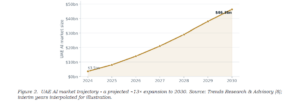
The economic prize is large but must be read with care. Analyst projections put AI’s contribution to UAE GDP at roughly 13.6% – about US$96 billion – by 2030, with the domestic AI market forecast to grow from around US$3.5 billion in 2024 to US$46.3 billion by 2030. On employment, the economy is projected to need roughly 1.03 million additional workers by 2030 amid the AI and digital push. Crucially, these figures describe AI across the whole economy and predate the agentic mandate; the government programme is best understood as the implementation engine that pulls public-sector value forward and signals intent to private capital, not as the source of the entire figure.
3. Why the UAE Is Moving - and Moving First
The mandate is the culmination of the strategy set in 2017, accelerated by directive. Five drivers explain the urgency.
• Diversification economics. Oil still anchors fiscal revenue. AI is one of the few levers that adds GDP without adding hydrocarbons – PwC models AI at close to 14% of UAE GDP by 2030, the highest relative impact in the region.
• A genuine productivity gap. Gulf economies have historically posted weak productivity growth; agentic automation targets the administrative core of the public sector, where throughput, not headcount, is the bottleneck.
• The scale advantage of a small state. With roughly 50 federal entities and a centralised Cabinet Affairs command structure, the UAE can mandate, coordinate and monitor transformation at a cadence larger bureaucracies cannot match.
• Global positioning and capital gravity. Being demonstrably “AI-first” attracts compute investment, talent and enterprise relocation; the plan is as much an FDI and soft-power instrument as an efficiency programme.
• Workforce structure. A predominantly expatriate labour market gives the state unusual flexibility to reshape roles quickly – while raising the stakes on reskilling nationals into the high-value roles the transition creates.
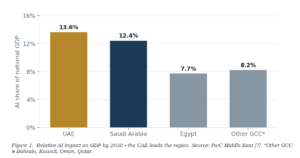
So what? The UAE’s edge is not the size of the prize – Saudi Arabia captures more in absolute dollars – but the speed and concentration with which a compact, directive government can convert ambition into deployed systems.
4. The Supply Side - National AI Champions
The government mandate and Dubai’s private-sector deadline are demand-side instruments – they oblige adoption. On the supply side, the UAE’s national AI champion, G42, and its operating companies are building the agentic systems that make the mandate deliverable. Reading the two together is essential: the same directional push runs simultaneously through government, the private sector, and the sovereign technology stack. The two-year timeline is credible precisely because demand and supply are being driven forward at once.
G42, Inception and Presight
G42’s structure maps neatly onto the agentic agenda. Inception, its agentic-AI company, provides the Catalyst platform and a sovereign enterprise super-assistant, “InceptionClaw,” built on UAE-native guardrails and designed to act proactively across email, calendars and workflow tools rather than wait for prompts. Presight, its applied-AI company, builds data-driven intelligence layers for specific sectors and clients. Together they supply the platforms, models and guardrails the public and private mandates will run on.
• SME scale-up. On 21 May 2026 – one day after the government’s Agentic AI Retreat – Presight and the Abu Dhabi Chamber signed a partnership to scale agentic AI across the Chamber’s 102,000+ registered SMEs, beginning with a pilot cohort.
• Sovereign enterprise assistant. Inception launched InceptionClaw on its Catalyst platform (Compass GPT-5.x models), with phased rollout across the G42 ecosystem and early access for government and enterprise clients.
• AI agents as accountable staff. G42 began formally recruiting AI agents into enterprise roles – with technical validation, probation periods and outcome-based performance – signalling a move from experimentation to structured workforce design.
• Sovereign-AI export. G42’s Digital Embassies framework, sovereign-AI agreements abroad, and large compute build-outs position the UAE as an exporter – not just an adopter – of agentic infrastructure.

The financial-services through-line
The clearest convergence with regulated finance runs through Presight and Inception. The G42–Santander partnership pairs Inception’s Catalyst platform with a Presight-built personalised financial-intelligence layer – described as among the largest enterprise agentic-AI mandates in European and Latin American banking, and G42’s first truly global banking deal. Domestically, Presight’s work with First Abu Dhabi Bank (FAB) extends the same model into the UAE’s largest bank. For GCC banks and regulators, this is the practical face of the agentic shift: sovereign, accountable agents embedded in core financial workflows.
So what. The mandate is not an isolated government directive. It sits atop a sovereign technology stack – G42, Inception, Presight – already deploying agentic systems across SMEs, domestic enterprises and global banks. Demand-side mandates and supply-side champions are pushing in the same direction at the same time, which is what separates this programme from a conventional national AI strategy.
5. What the Transformation Is Worth
Value accrues through three channels: productivity gains from automating workflows, consumer and service-quality benefits, and a fast-growing domestic AI market in compute, software and services. The public-sector mandate is the catalyst that de-risks private investment across all three. Two figures are frequently conflated and should be kept distinct. The ~US$96–100 billion number is AI’s modelled contribution to UAE GDP by 2030 – value created across the whole economy. The ~US$46 billion figure is the size of the AI market itself – chips, cloud, platforms and services. The first is the outcome; the second is the spend that produces it.
Where AI value concentrates
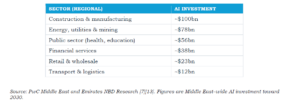
Across the wider Middle East, AI investment and value concentrate in a handful of sectors. The pattern is directional for the UAE public-sector mix and underlines why government operations are a priority target.
The financial-services lens
For regulated finance, PwC models AI at 13.6% of financial-services sector GDP – roughly US$38 billion regionally – with the sharpest near-term gains in fraud and anti-money-laundering monitoring, credit decisioning, customer operations and regulatory reporting. The agentic shift turns “AI literacy” into an operating requirement: supervisory bodies such as central banks and market authorities must now assess autonomous decisioning, model risk and accountability – not merely data privacy. That is a structural demand signal for capability-building across the GCC banking sector.
So what. The fiscal case for government is less about new revenue and more about cost-to-serve and cycle time: faster permits, audits and approvals compound into investor confidence and a measurable ease-of-doing-business dividend.

6. The Jobs Created, Replaced, and Rewritten
The defining feature of this transition is that net employment is projected to rise, not fall – but composition changes sharply. ServiceNow and Pearson estimate the UAE will need roughly 1.03 million additional workers by 2030 as economic expansion and AI adoption accelerate. The risk is therefore not mass unemployment; it is a skills mismatch between the roles automated away and the roles created.
Globally the directional pattern is consistent: the World Economic Forum’s 2025 outlook projects roughly 170 million roles created and 92 million displaced by 2030 – a net gain – with close to 39% of core skills turning over. Earlier McKinsey work flagged that a large share of current Gulf work activity is technically automatable, which is precisely the surface agentic government targets.
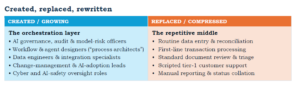
Most roles fall in neither column – they are rewritten. A finance officer, auditor or case worker keeps the job title but supervises agents, handles exceptions, and is measured on judgement rather than throughput. This is why the UAE paired the mandate with its largest-ever AI training effort, reported to target on the order of 80,000 government employees.
So what. The binding constraint is reskilling velocity. Net job growth only materialises if displaced workers are routed into the orchestration layer faster than automation removes the repetitive middle – a training-and-redeployment problem, not a technology one.
7. Why Agentic Is an Order Harder Than Generative
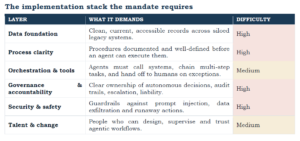
A chatbot that gives a wrong answer wastes a minute. An agent that takes a wrong action issues a payment, approves a permit, or files a report. Autonomy raises the cost of every failure mode, which is why the engineering and governance burden is disproportionate to the model itself. The mandate’s own selection criteria – documented procedures, availability of up-to-date data, degree of automation – implicitly acknowledge this.
The 90-day reality
The mandate structures delivery in three phases – exploration, design, and implementation planning – inside each 90-day window. Read carefully, the cycle is engineered to reach a launched, scoped service, not a fully production-hardened autonomous system. That is a sensible de-risking move: it forces entities to ship something real and learn, while harder problems – cross-system integration, liability, scaling – are tackled iteratively. The honest risk is “pilot purgatory”: many promising 90-day launches that never industrialise into resilient production.
So what. Model capability is not the constraint. Data readiness, process documentation and accountability frameworks are. Entities with clean data and well-mapped processes will compound advantage; those without will spend their first cycles simply reaching a usable baseline.
8. What to Watch Over the Next Four Quarters
• Cycle-to-production conversion. The signal that matters is not how many 90-day pilots launch, but what share survive into resilient, scaled services.
• Accountability precedent. The first publicised case of an autonomous government decision being challenged or reversed will shape the regional governance template.
• Reskilling throughput. Whether the 80,000-employee training effort produces orchestration-layer talent fast enough to keep net job creation positive for nationals specifically.
• Spillover to regulated sectors. Central banks and market authorities adapting agentic governance into supervision – a direct driver of demand for AI-capability programmes across banking and capital markets.
• Private-sector follow-through. Dubai’s parallel two-year private-sector deadline means the public mandate will be tested against commercial adoption in lockstep.
The strategic implication for capability builders. As autonomy moves into core operations, the scarce skill is no longer how to use a model but how to design, supervise and audit systems that act. For training and programme designers serving GCC banks and regulators, the opening lies in agentic governance, model risk, AI-augmented operations, and the conversion of subject-matter experts into agent supervisors – the orchestration layer that determines whether the economic case is realised.
Looking to build the skills, capabilities and confidence to lead AI-driven transformation? Explore our AI and digital transformation solutions →